Who was Jacob Desbovery Esq (1659-1722)?
Jacob des Bouverie (or Desbovery as inscribed in the Book of Maps) was a descendant of Laurens des Bouverie (1536-1610), a French Huguenot born in Lille. Laurens came to England to escape the religious oppression of Catholic France and settled in Canterbury. During the 17th Century his descendants established themselves as London merchants; their business is documented in a series of account books held in the Wiltshire & Swindon Archive. Two of Jacob’s brothers, William and Christopher, were important Levant merchants, the former also serving as Deputy Governor of the Bank of England (1707-09) and the latter as a director of the South Sea Company. Jacob himself was based in Aleppo in the 1680s as an agent for his father and other merchants.
In 1695 Jacob was elected as Member of Parliament for Hythe. At that time Jacob was recorded as living in Barking, but in 1697 he bought the Dixwell estates in Kent, including the manor and hundred of Folkestone, whereby he became lord paramount of the hundred of Folkestone. Jacob’s position as a large landowner in Kent was recognised with his appointment as a deputy-lieutenant in December 1697 (a position he held until at least 1702) and as a justice in July 1700 until his death in 1722. Information about Jacob’s political affiliations and the social/economic issues under discussion by Parliament can be found at BOUVERIE, Jacob des (1659-1722), of Allhallows, Barking, London and Terlingham, Kent | History of Parliament Online
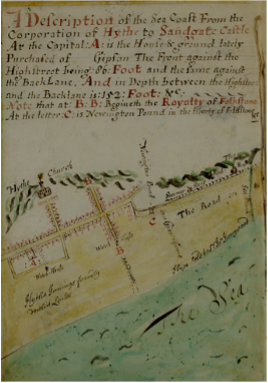
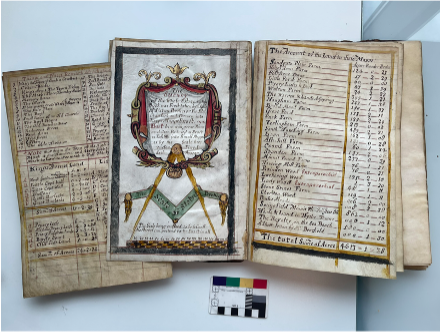
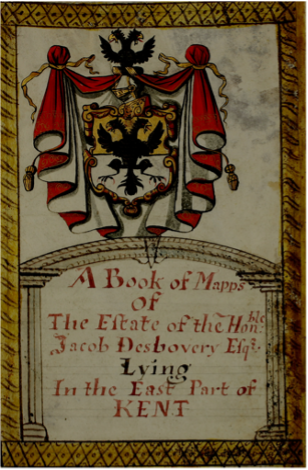
Jacob consolidated his investments in East Kent and in 1698 arranged for a land and tenant survey and maps to be drawn up, taking almost a year to complete. Five large maps were created and are currently kept in Longford Castle (the home of the Earls of Radnor). A ‘working copy’, most likely used by the estate steward to collect rent was produced entitled “A Book of Maps of the Estate of the Hon Jacob Desbouvery Esq lying in the East Part of Kent” – this is the volume which is featured here.
The family history of the Bouverie family can be hard to follow because first names were often repeated – for instance, the first Viscount Folkestone was another Jacob (1694-1761), the nephew and heir of ‘our’ Jacob who (along with Jacob’s older brother Sir Christopher des Bouverie (1631-1732)) acted as Executor of his will in 1727. Viscount Jacob had a brother Edward (1688-1736), whose estates he also inherited. The prefix ‘des’ was dropped by Jacob in 1736 by private act of Parliament.
The second Viscount Folkestone was Jacob’s son William Pleydell-Bouverie (1725-1776). William married Harriet Pleydell in 1748; Pleydell was added to the family surname following inheritance of estates. He became the first Earl of Radnor in 1765, starting a long association with the history of Folkestone and surrounding area. One only need take a look around a modern map of Folkestone and spot how many street names reflect the Bouverie connection.
Documents relating to the family history can be accessed in the Radnor Collection at the Swindon and Wiltshire Archives.